Five-star tower beside Osaka Station with an indoor pool, spa and a starred restaurant. Guests praise the staff and service and the easy station access for day trips.
Umeda / Kita
Search Expedia for this hotelpartner siteCity guide / Japan
Osaka is Japan's street food capital and the main gateway to the Kansai region, a short train ride from Kyoto, Nara and Kobe.
The review
Japan's loudest, hungriest city: neon canals, cheap great food and an easy base for Kyoto and Nara, if you drop the temple expectations.
Osaka is worth it for travelers who come to eat, walk at night and use it as a rail hub for the Kansai region. Reports agree on the core: Dotonbori after dark, takoyaki and kushikatsu from stalls, retro Shinsekai and a city that is cheaper and easier to read than Tokyo or Kyoto. One 2025 writer calls it the cheapest of the three Golden Route cities, with seven mid-range hotel nights costing only a little more than three in Kyoto.
The hard truth is that Osaka is not pretty in the way Kyoto is. A 2025 blogger who arrived straight from Kyoto found it run-down, gray under its elevated highways and a poor city for strolling, and ranked it third among Japan's big three. The famous strips are also crowded from late afternoon, Kuromon Market has drifted toward tourist pricing, and many stalls take cash only. If your picture of Japan is wooden lanes and temples, this is the wrong city to stay in for long.
The fix is to treat Osaka as a food-and-nightlife base with a plan. Eat at Kuromon on a weekday morning, go to Dotonbori just after sunset on a Tuesday to Thursday, add one local district such as Tennoji or Nakazakicho, and give temples to Kyoto or Nara on day trips. Three days is the figure several writers settle on. If you also want the capital, Tokyo is a different pace entirely.
The long read
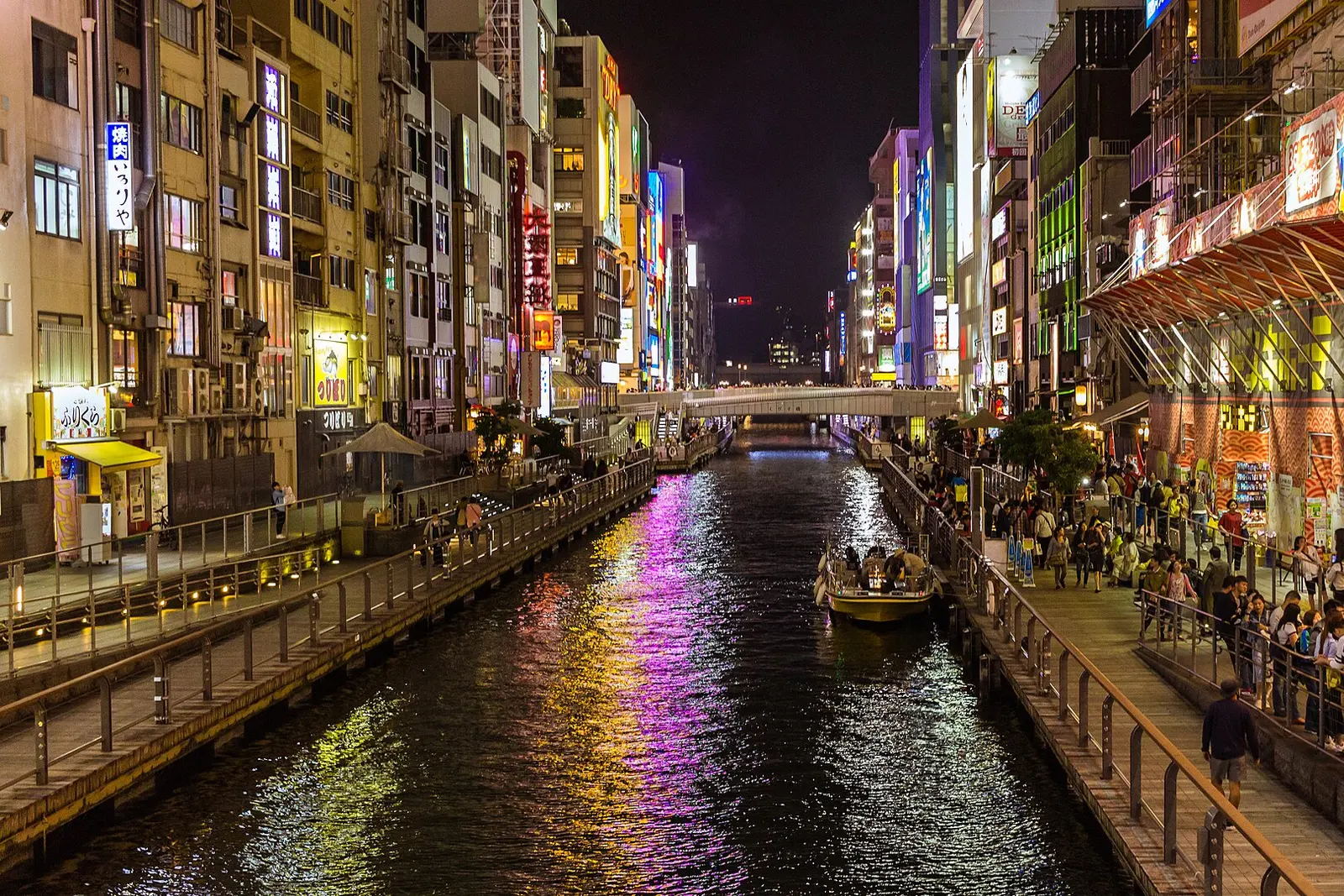
Dotonbori is the Osaka postcard: a canal lined with giant animated signs, the Glico runner on the bridge and food stalls steaming from late afternoon. Travelers describe it as shoulder to shoulder at the main strip, with queues outside the famous restaurants. One 2026 guide says quiet is not realistic here, and another logs the worst crowds from about 6 to 9 PM, especially Friday and Saturday nights.
The practical move is timing. Arrive in late afternoon, catch the Glico sign as it lights at sunset and eat before the peak. Weekday evenings are calmer. Some visitors take the 20 minute canal loop, listed in 2026 at 2,000 yen for adults (about EUR 11.31), for the angle on the signs from water level.
Next door, Shinsaibashi is the long covered shopping arcade. One 2026 blogger found its sheer number of shops overwhelming and bought nothing, while others treat it as the calmer, more local side of the neon district. A March 2026 report says the city is testing crowd-flow signage around Dotonbori, a sign that the strip is under real pressure.
Food is the reason most people come. The standard order is takoyaki, okonomiyaki and kushikatsu, with crab and oysters at the market. A 2026 market guide lists takoyaki at about 500 to 600 yen for six (EUR 2.83 to 3.39) and oysters at 300 to 500 yen each (EUR 1.70 to 2.83). Several writers say to eat standing at the stall and not wander with food.
Kuromon Market is where reports split. The 2026 guide says it is still worth it on a weekday morning, ideally before 9 AM, but warns that some vendors now aim at one-time buyers, with wagyu skewers at 800 to 2,000 yen (EUR 4.52 to 11.31) against 400 to 600 yen for the same idea at a normal yakitori place. Another 2026 writer repeats the claim that most people call it a tourist trap. Go early, pick the egg and seafood specialists and skip gift-set stalls.
Carry cash. Reports say most market stalls and many takoyaki and kushikatsu counters take cash only, and one guide suggests 5,000 to 10,000 yen in small notes (EUR 28.28 to 56.55). At the shared-sauce kushikatsu shops, dip once only.
Namba, around Dotonbori, is the default first-timer pick: food, nightlife and the Nankai line from the airport are all close. Several guides add the catch, that streets near the canal stay noisy past midnight, so book a few blocks back if you sleep lightly. Shinsaibashi is the nearby alternative that guests describe as a calmer mix of central and local.
Umeda, also called Kita, is the transport hub. Writers rate it best for Kyoto, Kobe and Himeji day trips and for a multi-city trip, and calmer and more polished than Namba. The station complex confuses first-day arrivals with luggage, and rush hour is crowded.
Tennoji is the cheaper, more local option near Shinsekai and the Abeno Harukas tower, with a direct line to the airport and Nara. Shin-Osaka suits early bullet train departures but goes quiet after 9 PM. The Bay Area near Universal City makes sense only if the theme park is the point.
Shinsekai gives the retro Osaka: the Tsutenkaku tower, kushikatsu shops and a look one writer likens to Blade Runner after dark. A 2025 blogger who was lukewarm on the city still ranked it, Dotonbori at night and the Umeda Sky Building at sunset as highlights. Tennoji Park is described as relaxed and local, and one guide notes a free observation deck on the 16th floor of a nearby tower.
Osaka Castle is the main historic stop, with keep admission listed at 1,200 yen in 2026 (about EUR 6.79). Guides advise going early in the morning to beat the crowds, and note that the castle closes from 28 December to 1 January.
Universal Studios Japan is the big day out. A 2026 blogger found queues shorter than the app predicted, while a May 2026 family review says a mid-week day is best. Tickets are date-priced and sold online, with a 2026 guide quoting one-day passes from about 8,600 yen (EUR 48.63). Do not squeeze it into a two day trip.
Osaka works as a base because the trains are easy. Writers put Kyoto at about 30 minutes from Umeda, Kobe at 25 and Himeji at under an hour. For temples, bamboo and old streets, go to Kyoto rather than hunting for them in Osaka.
Nara is the other standard outing. A 2025 blogger who disliked Osaka's look found Nara, with its temples and deer, matched expectations. Kobe gets a weaker report, called unremarkable beyond the waterfront.
Forum and blog advice on base choice is consistent: for trips under about five nights, stay in Osaka and day trip, and move to Kyoto only for a longer stay or a ryokan night. Osaka lodging is also usually cheaper than Kyoto.
Families come for Universal. A May 2026 review of a family with boys aged 10 and 13 calls the park absolutely worth it, with mid-week visits and Express Passes on busy days making the difference. A guide aimed at toddler families says the pass is less essential for them.
Couples tend to prefer Shinsaibashi or Umeda over the loudest part of Namba, and solo travelers like the walkable food streets and late-opening counters. Women and solo guests do not report particular safety problems in the sources, but trains and busy strips are crowded, so keep bags zipped and plan for the last train.
The pitfalls
Guides report the strip is packed from late afternoon, with the worst crowding around 6 to 9 PM and on Friday and Saturday nights. Arrive just after sunset on a Tuesday to Thursday, take the Glico photo early and eat away from the bridge to avoid queues.
A 2026 market guide says weekend afternoons after 11 AM are packed and some stalls charge a clear premium, such as wagyu skewers at 800 to 2,000 yen (EUR 4.52 to 11.31). Stalls also wind down in the afternoon, so go on a weekday morning.
Several 2026 writers warn that many stalls and takoyaki counters accept cash only. Withdraw yen at a convenience-store ATM and carry small notes, since card and IC acceptance varies even in popular districts.
Guides warn that streets around the canal stay loud past midnight and say light sleepers should avoid Namba or book a few blocks away. Check for soundproofed rooms before booking.
Osaka Prefecture charges a per person per night tax that rose on 1 September 2025: 200 yen from 5,000 yen, 400 yen from 15,000 yen and 500 yen from 20,000 yen. Room rates online may not include it, so check the final total.
A 2025 blogger arriving from Kyoto found Osaka run-down and industrial under its elevated highways. Another guide says it will disappoint anyone expecting wooden machiya streets. Keep temples for Kyoto or Nara day trips.
Third-party figures for the Nankai limited express and the Haruka vary a lot. Nankai's Rapi:t needs a base fare plus a limited express charge, so check its fare search, and the discounted Haruka ticket (1,600 to 1,900 yen to Tennoji or Osaka) is only for foreign visitors on temporary visitor status.
When to go
Best time
April to May and late October to November
Travelers describe comfortable walking weather and long, bright evenings in spring, while autumn brings light displays starting in November. Late May reached about 29C in one 2026 report.
Peak season
Late March to early April, Golden Week and New Year
Guides report heavy crowds and higher hotel rates around cherry blossom weeks and Golden Week, and advise avoiding 28 December to 3 January when domestic travel peaks and shops close.
Shoulder season
June to September
Summer is hot and humid, and a 2026 crowd guide warns the canal promenade at Dotonbori is exceptionally crowded on summer evenings, with Shinsekai suggested as a calmer alternative.
Off season
December to February
Winter is cold and dry, with rare snow and night lows that can drop below zero, so coats and gloves are advised. Crowds ease apart from weekends and the year-end stretch.
Reports favor spring and late autumn: April to May and late October to November give comfortable walking weather. Late March to early April and Golden Week bring heavy crowds, and a late May trip reached about 29C. Winter is cold and dry, with free light displays along Midosuji, but guides advise avoiding the New Year stretch when many shops close.
Getting there and around
| Airport | Distance | To the centre | How |
|---|---|---|---|
| KIX Kansai International Airport | 50 km | about 45 min | Nankai Rapi:t reaches Namba in as little as 34 minutes and the Airport Express in about 45, per Nankai. The Rapi:t needs a base fare plus a limited express charge, and Nankai publishes no single all-in figure we could confirm, so use Nankai's fare search for the current total. The discounted Haruka ticket for foreign passport holders on temporary visitor status (sold on or after 1 November 2026) lists 1,600 yen to Tennoji, 1,900 yen to Osaka or Shin-Osaka and 2,700 yen to Kyoto (about EUR 9.05, EUR 10.74 and EUR 15.27 at 176.83 yen per euro on 2026-11-13). Distance to the city is roughly 50 km. (source, checked Nov 2026) |
| ITM Osaka Itami Airport | n/a | n/a | Osaka Monorail lists 200 yen from Osaka Airport to Hotarugaike and 340 yen to Senri-chuo (about EUR 1.13 and EUR 1.92 at 176.83 yen per euro), where you change to the Hankyu line or Osaka Metro for the city. Airport limousine buses to Umeda also run; check the operator for the current fare, journey time and last departures. (source, checked Nov 2026) |
Most sights sit near a subway or rail station, and writers find navigation easier than in Kyoto. From Kansai Airport, the Nankai Rapi:t reaches Namba in as little as 34 minutes, while the discounted Haruka ticket for foreign visitors lists 1,600 yen to Tennoji and 1,900 yen to Osaka or Shin-Osaka (about EUR 9.05 and EUR 10.74 at 176.83 yen per euro). City buses run a flat 210 yen adult fare (about EUR 1.19) per the operator.
Where to stay
We earn a commission if you book through our links. It never changes a verdict. How this works
High-end stays whose guests report the setting and service earn the rate.
Five-star tower beside Osaka Station with an indoor pool, spa and a starred restaurant. Guests praise the staff and service and the easy station access for day trips.
Umeda / Kita
Search Expedia for this hotelpartner siteSits directly above Nankai Namba, so guests praise the airport link, spacious clean rooms and a spa with indoor pool. Complaints centre on slow check-in and a breakfast that feels short of five stars.
Namba / Minami
Search Expedia for this hotelpartner siteOccupies the upper floors of the Abeno Harukas tower. Guests single out the city views, attentive staff and breakfast buffet, while one finds the bar overpriced.
Tennoji
Search Expedia for this hotelpartner siteOccupies the top floors of a Midosuji tower near the Shinsaibashi shopping district, with about 160 rooms and a spa. Reviewers describe polished, precise service and a quiet atmosphere.
Honmachi
Search Expedia for this hotelpartner siteThe comfortable middle: well placed, well run, priced for a normal trip.
Four-star hotel above a large shopping complex with a basement link to Umeda station and a walkway to Osaka Station. Guests praise breakfast and staff, though rooms are small and luggage space is tight.
Umeda / Kita
Search Expedia for this hotelpartner siteDesign-led upper mid-range hotel that blogs describe as modern, spacious and good value, close to Dotonbori but not in its loudest stretch.
Namba / Minami
Search Expedia for this hotelpartner siteBoutique-style hotel in the quieter northern part of Shinsaibashi, a short walk from the shopping arcade. Guests praise the clean rooms, breakfast, staff and location.
Shinsaibashi
Search Expedia for this hotelpartner siteTall hotel about a minute from Universal City station and two minutes from the park, with an indoor onsen. Guests like the roomy clean rooms and staff, but some fault the breakfast and beds.
Bay Area (Universal City)
Search Expedia for this hotelpartner siteCheaper beds that travelers still rate well for location and cleanliness.
Simple, clean hotel close to the Shinsaibashi shopping street and the Glico sign, with robot-assisted check-in. Blogs praise it as affordable and well placed for the food district.
Shinsaibashi / Namba
Search Expedia for this hotelpartner siteBudget hotel one block from Namba Yasaka Shrine and a short walk from Namba station and Dotonbori. Blogs flag it as good value for the district.
Namba / Minami
Search Expedia for this hotelpartner siteHostel opened in late 2024 with private rooms that have their own bathroom, in the cheaper, more local Tennoji district near Shinsekai. Scores are high but based on few reviews.
Tennoji
Search Expedia for this hotelpartner siteChain hotel with 181 rooms, a restaurant and bar and breakfast available for a surcharge, located near Osaka Station City and Grand Front Osaka on the Umeda side.
Umeda / Kita
Search Expedia for this hotelpartner siteQuestions
Two to three days covers the food streets, Osaka Castle, a local district and one major sight. Add one or two nights for Kyoto and Nara day trips, or a full extra day if you want Universal Studios Japan.
Reports call it the cheapest of the three Golden Route cities, with food at stall prices and lodging below Kyoto. Budget for the accommodation tax of 200 to 500 yen per person per night (about EUR 1.13 to 2.83) on most rooms.
Namba or Shinsaibashi suit food and nightlife, and Umeda suits day trips and long rail journeys. Tennoji is cheaper and more local. Stay a few blocks from the Dotonbori canal if you are a light sleeper.
Yes, mainly for Universal Studios Japan, which a May 2026 family review calls absolutely worth it for mixed ages. Go mid-week, buy date-priced tickets online and consider Express Passes on weekends and holidays.
Yes. Several 2026 guides say many market stalls and takoyaki or kushikatsu counters accept cash only. Carry small notes, and withdraw yen at a convenience-store ATM.
Writers advise Osaka as the base for trips under about five nights, with one or two day trips to Kyoto. Move to Kyoto for a longer stay or a traditional inn night.
How this guide was written. We read 19 traveler reports about Osaka published between Feb 2025 and Sep 2026, 1 of them mainly negative, and checked the facts against official sources in Nov 2026. Nobody on the team claims a visit; hotel picks are chosen from what guests report, never from what they pay us. How we judge.
Our first Osaka verdicts are on the way.
Plan your Osaka trip
Where to stay
12 hotel picksLuxury, mid-range and budget, cross-checked against traveler reports
Getting there
Airports near OsakaDistances, transfer times and the options that work
Book a private transfer partner site
Keep exploring
Gear verdicts from our sister site, Real Buyer Experiences: