Split / The verdict
Is Diocletian's Palace worth it?
Diocletian's Palace is the rare Roman monument that never became a museum: the 4th century retirement complex is Split's entire old town, free to wander day and night and still lived in by about 3,000 people. The Peristyle, the four gates and the polished lanes cost nothing; only a few interiors ticket, and of those the vaulted cellars earn their 10 EUR most clearly. Go early or late, because midday in high summer turns the lanes into a slow queue.
By The Real Traveler Experiences team. We earn a commission if you book through our links. It never changes a verdict.
The Split story
Split is the rare city where you sleep inside the monument. [Diocletian's Palace](/split/diokletian-palace/) is not a fenced ruin but the working old town, with three thousand people living and running bars, bakeries and apartments inside the Roman walls, and the Riva promenade out front acts as the city's living room. Travelers rate it a better-rounded stop than Dubrovnik for most trips: cheaper, more lived-in, and fronted by a ferry port that makes it a launchpad rather than a cul-de-sac.
The verdict in 30 seconds
Go
Diocletian's Palace is the rare Roman monument that never became a museum: the 4th century retirement complex is Split's entire old town, free to wander day and night and still lived in by about 3,000 people. The Peristyle, the four gates and the polished lanes cost nothing; only a few interiors ticket, and of those the vaulted cellars earn their 10 EUR most clearly. Go early or late, because midday in high summer turns the lanes into a slow queue.
Go if
- You are in Split for the first time: the palace is not one sight on the list, it is the old town itself.
- You like Roman architecture best when it is still doing a job, housing cafes, homes and shops instead of sitting behind ropes.
- You can visit before 9am or after 6pm, when the cruise groups leave and the lanes empty out.
Skip if
- You expect a single-gated monument with one ticket and a fixed route: this is a lived-in neighborhood with a dozen ways in.
- Slick stone underfoot or steep open-sided staircases are a problem, since the lanes are polished marble and the bell tower climb is narrow.
- Your only window is midday in July or August, when the Peristyle packs shoulder to shoulder.
What it costs
- Substructures of Diocletian's Palace, adult: €10 (Split City Museum ticket for the vaulted cellar halls; sold at the door and online). Official source, checked Oct 2026.
- Substructures, reduced (pupils, students, pensioners, Tourist Card): €8 (children under 7 free; family ticket for parents with under-15s is 18 EUR). Official source, checked Oct 2026.
- Substructures, family ticket: €18 (covers parents with children under 15; open daily 8:30 to 20:00, last entry 30 minutes before close). Official source, checked Oct 2026.
What travelers report
Based on 13 traveler reports (Dec 2024 to Aug 2026) and the official sources linked on this page. 0 were negative.
What people like
- 5 of the logged reports stress the same point: this is a free, lived-in old town, not a cordoned museum, and roughly 3,000 people still call it home.
- 4 of the logged reports recommend early morning or evening visits to beat the midday cruise crowds on the lanes.
- 3 of the logged reports single out the cellars as the paid interior that most clearly earns its ticket.
- 2 of the logged reports call the bell tower view over the rooftops and harbor the best in Split.
- 1 logged report, a 45 minute resident's walkthrough, covers every gate, the basements and the quieter northern walls in one circuit.
What people complain about
- 2 of the logged reports warn the polished marble lanes are slick, especially in heat or rain.
- 1 logged report calls the cathedral combo-ticket menu confusing enough to feel like a con after buying the wrong one.
- 1 logged report describes buying cathedral tickets only to find parts closed that day, with no partial refund offered.
- 1 logged report finds the ticketed cathedral bits underwhelming beside the free streets outside.
- 1 logged report warns the Peristyle packs shoulder to shoulder midday in peak summer.
How to do it right
- Walk in free through any of the four gates: Bronze off the Riva is the classic approach, Golden Gate on the north side drops you by the Gregory of Nin statue, Silver and Iron feed the market and cafe streets.
- The Bronze Gate route passes through the cellars' free central hall, a barrel-vaulted passage lined with souvenir stalls. The paid Substructures wings, the intact Roman vaulted halls, branch off it with a ticket booth at the entrance.
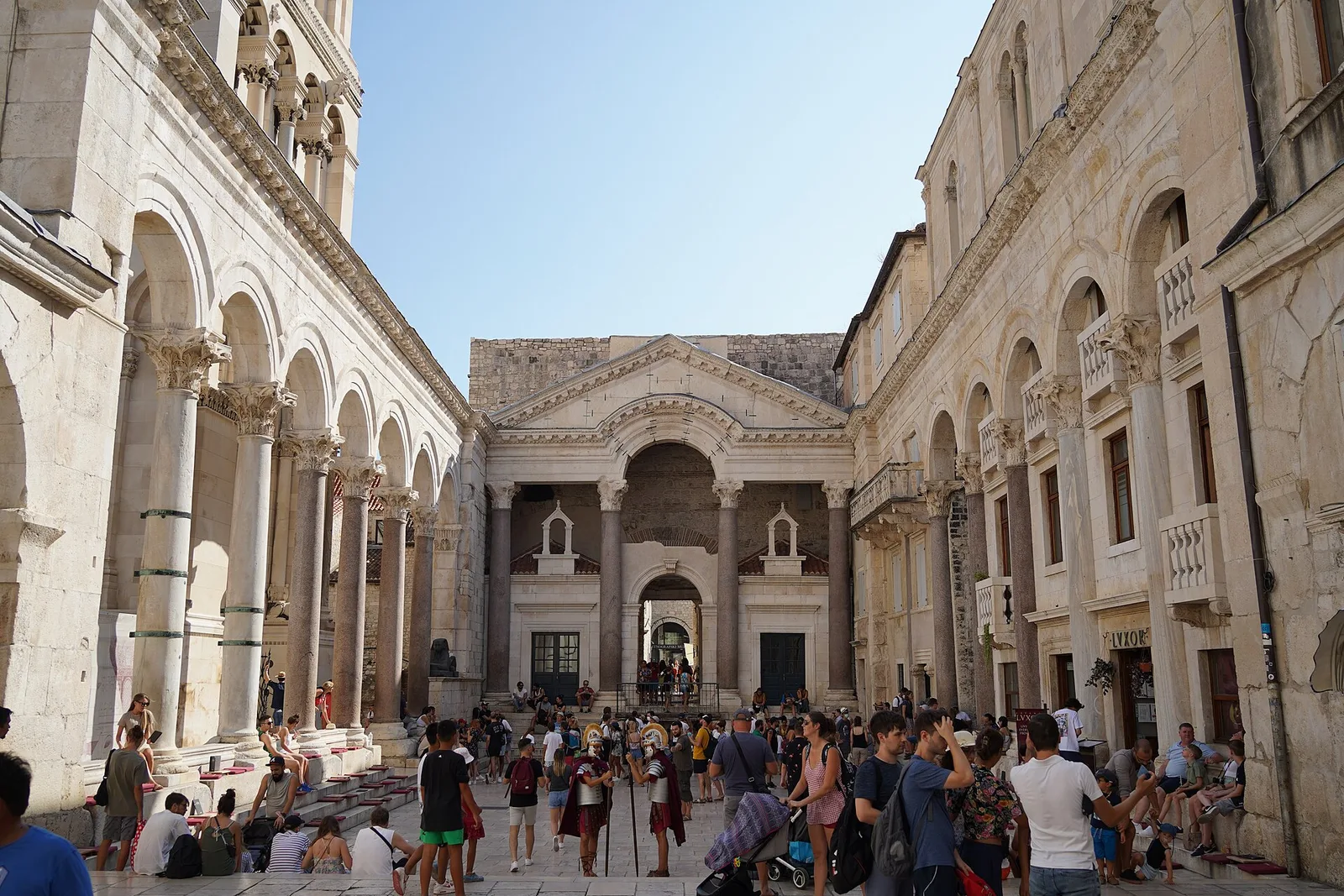
- At the Peristyle, the colonnaded court at the center, sit on the steps like the locals do. The cathedral and its ticket office are just off the square; the bell tower entrance is beside the cathedral doors.
- The cathedral, crypt, baptistery, treasury and bell tower are ticketed separately or in combo tickets at the door, with no official online price list, so confirm what each ticket covers before paying.
- Time the visit before 9am or after 6pm in summer. Reports put the cruise-ship crush between about 11:00 and 15:30, and the marble lanes are at their slickest and hottest then.
The trap to avoid
There is no single palace ticket, and visitors regularly overbuy. The lanes, squares and gates are free public space. The cellars are a city-museum ticket sold at their own booth. The cathedral complex sells per-part and combo tickets at a separate desk, and one logged report calls the combo structure confusing enough to feel like a trap. Decide which two or three interiors you actually want before you join any line.
What to do instead
Why this verdict
Diocletian’s Palace is the rare Roman monument that never became a museum. Built around 305 AD as the emperor’s retirement complex, it now forms Split’s entire old town: about 30,000 square meters of lanes, courtyards and gates that are free to enter at any hour, with roughly 3,000 people still living inside the walls. Five of the logged reports make the same point: you do not visit the palace so much as wake up inside it. The Peristyle, the Egyptian sphinx, the four metal-named gates and the vestibule all cost nothing.
Money only enters at the edges. The cathedral complex beside the Peristyle tickets its parts separately or in combos at the door, and the cellar substructures charge a 10 EUR city-museum fee. Of the paid interiors, reports most consistently endorse the cellars, the intact vaulted halls that propped up the emperor’s apartments and now host a small museum, and the bell tower climb, a narrow open-sided scramble rewarded with the best view over the rooftops and the harbor. The smaller cathedral parts get mixed marks, and the crypt is the piece most often called skippable.
The real variable is timing, not tickets. Reports put the cruise-ship surge between about 11:00 and 15:30, when the Peristyle packs shoulder to shoulder. Before 9am the lanes belong to residents and delivery carts; after 6pm the stone cools and the square fills with locals again.
Timing and tickets
The cellars are open daily 8:30 to 20:00 with last entry 30 minutes before close; an adult ticket is 10 EUR, reduced 8 EUR, families 18 EUR, under-7s free. The free Central Hall through the cellars is itself worth the walk, a vaulted market passage between the Riva and the Peristyle. Cathedral-complex tickets sell only at the door with no official online price list, so confirm exactly what each combo covers. Wear shoes with grip: the polished limestone lanes are famously slick.
Book or check times
Substructures: the museum inside the cellarsCellar tickets and opening hoursCathedral of Saint DomniusUNESCO listing for the palace complex
We earn a commission if you book through our links. It never changes a verdict. How this works
See the 90-minute palace walking tourpartner siteSee the palace and old town walking tourpartner site
Where to stay
Staying in Split?
Which area of Split to stay in, based on traveler reports. Search Split hotels on Expedia partner site
Questions
Is Diocletian's Palace free to enter?
Yes. The palace is Split's old town: the gates, lanes, squares and the Peristyle are free public space open around the clock. Only specific interiors charge: the cellar substructures (a 10 EUR city-museum ticket) and the cathedral complex parts, which sell per-part and combo tickets at the door.
What inside the palace is worth paying for?
The cellar substructures are the paid part most reports endorse: intact Roman vaulted halls below the Peristyle that show how the whole palace was engineered, with a museum exhibition inside. The bell tower earns its fee for the best rooftop view in Split if you can handle the narrow stairs. The cathedral's smaller parts draw more mixed reactions, and the crypt is the one report most often call skippable.
When is the best time to visit Diocletian's Palace?
Before 9am or after 6pm. Reports put the cruise-ship surge between about 11:00 and 15:30, when the Peristyle clogs. In the evening the lanes thin out, the stone cools and the square fills with locals instead of tour groups.
How long does Diocletian's Palace take?
A first pass through the lanes, gates and Peristyle takes 1 to 2 hours at a stroll. Add another hour or two if you do the cellars, the cathedral complex and the bell tower, and more again if you stop for the cafes and courtyard bars.
Is the bell tower climb difficult?
It is a narrow, steep, partly open-sided staircase, about 60 meters up. Reports call the first flights the worst and the summit view over the rooftops, harbor and Marjan Hill worth the climb. Anyone uneasy with heights or tight stairs should weigh it first.
Do I need a guided tour of the palace?
Not for the space itself, since the lanes are free and self-explanatory enough to wander. A guide pays off if you want the Roman-to-medieval story told coherently in one pass; several reports suggest a short group walk early in a Split stay, then re-wandering alone.
Pack for it
Gear verdicts from our sister site, Real Buyer Experiences: