Zadar / The verdict
Are the Sea Organ and Greeting to the Sun worth it?
Yes. Both installations are free and run around the clock on the northwest tip of the old town peninsula: the Sea Organ is 70 metres of marble steps hiding 35 pipes played by the waves, and the Greeting to the Sun is a solar-charged light disc that glows after dusk. The sound shifts with the sea state and passing boats; the crowd peaks at sunset; give it 30 to 60 minutes and stay past the light show.
By The Real Traveler Experiences team.
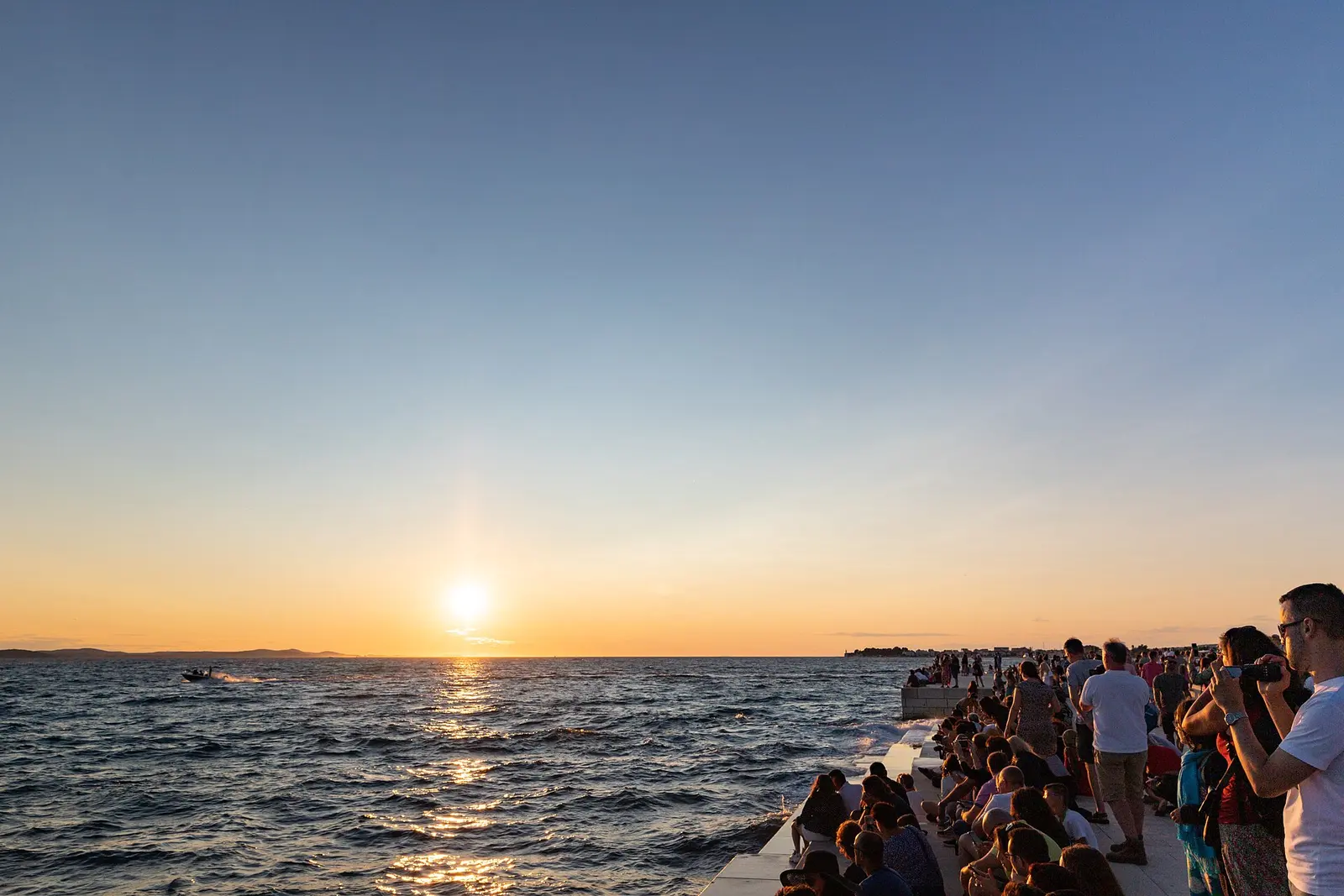
The Zadar story
Zadar is the most underrated city on the Dalmatian coast: a Roman-and-Venetian old town on a small peninsula, a seafront where the Sea Organ plays music off the waves and the Greeting to the Sun lights the dusk, and five national parks within day-trip reach. It is Split's smaller, calmer rival.
The verdict in 30 seconds
Go
Yes. Both installations are free and run around the clock on the northwest tip of the old town peninsula: the Sea Organ is 70 metres of marble steps hiding 35 pipes played by the waves, and the Greeting to the Sun is a solar-charged light disc that glows after dusk. The sound shifts with the sea state and passing boats; the crowd peaks at sunset; give it 30 to 60 minutes and stay past the light show.
Go if
- First-time visitors who want Zadar's signature moment: a sunset with the sea itself playing the soundtrack.
- Budget travelers: both installations are free, open at all hours and need no ticket or booking.
- Swimmers who like a dip with the experience; locals swim off the same stretch of promenade.
- Sound-art and design fans curious how 35 pipes and a solar array became a city's identity.
Skip if
- You cannot share space with a crowd: on August evenings the promenade packs to the steps, so come at sunrise or in the off-season instead.
- You expect a concert: the organ is ambient and sea-dependent, and on glassy-calm days it barely murmurs.
- You are in a rush through town: the payoff needs unhurried sitting time, ideally from golden hour into blue hour.
What it costs
- Sea Organ admission: €0 (free and accessible at all hours, per the city tourism board). Official source, checked Oct 2026.
- Greeting to the Sun admission: €0 (free; the light display activates after dark, powered by the day's stored solar energy). Official source, checked Oct 2026.
What travelers report
Based on 12 traveler reports (Apr 2025 to Jun 2026) and the official sources linked on this page. 0 were negative.
What people like
- 5 of the logged reports name the sunset pairing of organ and light disc the city's defining evening ritual.
- 2 of the logged reports note the organ sounds deeper when larger waves or boat wakes push the pipes.
- 2 of the logged reports describe spontaneous applause at sundown from the crowd on the steps.
- 2 of the logged reports emphasize it is free, unstaffed and open at any hour.
What people complain about
- 3 of the logged reports flag heavy sunset congestion on the promenade and steps in peak season.
- 2 of the logged reports call the sound subtle or faint on calm days, more ambient instrument than performance.
- 1 logged report, filed by a cruise passenger, frames it as a quick stop rather than an evening.
- 1 logged report notes calm early-morning seas soften the organ to a murmur.
How to do it right
- Walk the waterfront promenade to the northwest tip of the old town peninsula; the organ is the stepped marble edge, the light disc sits right beside it.
- Arrive 45 to 60 minutes before sunset for a seat on the steps; the solar disc's light program only registers properly after dusk.
- Know that the organ sounds different every day: calm seas murmur while waves and passing boat wakes push deeper chords through the pipes.
- Stay 20 to 30 minutes after the sun drops; the disc cycles through its light sequence as the crowd thins.
- For a quieter visit come at sunrise or midday in shoulder season; the organ is audible whenever waves lap, crowds or none.
- Pack a swimsuit in season: people swim off the promenade beside the organ on warm days.
The trap to avoid
Treating the pair as a daytime box to tick. Before dusk the light disc is just a floor of glass panels and the organ can fade to a murmur on calm days; arriving right at sunset means sharing the steps with every tour group in town. The winning play is either a long, slow sunset that runs into the lit-up disc, or a near-empty early morning when the sea does the same performance for nobody.
What to do instead
Why this verdict
Go, because it is the rare headline attraction that asks nothing of you. No ticket, no queue, no closing time: the Sea Organ is 35 pipes under 70 metres of marble steps that the waves play for free, and the Greeting to the Sun beside it stores the day’s solar energy and pays it back as a light field after dusk. Reports agree the pairing is Zadar’s signature evening, and several describe applause rippling through the crowd as the sun drops.
The experience is weather-dependent, which is the real caveat. On calm days the organ murmurs rather than plays, and the disc barely registers before dark. Reports and locals agree the fullest sound comes when seas run higher or boat wakes roll in, and the video log confirms both the murmur and the fuller chords. So the visit rewards the patient: sit for half an hour, let a few cycles pass.
Crowds are the other cost, but a manageable one. August sunsets pack the steps shoulder to shoulder; dawn and shoulder-season afternoons give the same performance nearly alone. Either way, budget thirty to sixty minutes and stay past the light display’s first cycles.
Timing and tickets
Both installations are free and open at all hours per the city tourism board. Sunset is the famous slot, meaning arrive 45 to 60 minutes early for a step; the disc’s light program only shows properly after dusk, so stay 20 to 30 minutes past the drop. Swimmers do share the waterline beside the organ in season.
Book or check times
Sea Organ on the Zadar tourism boardGreeting to the Sun on the Zadar tourism board
Questions
Where exactly are the Sea Organ and Greeting to the Sun?
On the northwest tip of Zadar's old town peninsula, along the waterfront promenade. The Sea Organ is built into 70 metres of marble steps at the sea's edge and the Greeting to the Sun light disc sits immediately beside it; walk the promenade from the old town and you cannot miss the steps.
How much does it cost to see the Sea Organ and Greeting to the Sun?
Nothing. Both are free public installations, open around the clock, and the city tourism board lists them without any ticket or booking.
What is the best time of day to visit?
Sunset is the famous slot: the organ plays as the light turns and the solar disc glows once darkness falls, with the same crowd as everyone else. Early morning and shoulder-season afternoons give you the same sounds with far fewer people.
How long should I plan for the Sea Organ?
Thirty to sixty minutes covers most visits: sit on the steps, listen through a few wave cycles, then watch the light disc after dusk. Reports suggest treating it as an evening ritual rather than a five minute photo stop.
Does the Sea Organ sound the same every time?
No. The 35 pipes respond to wave energy, so a glassy-calm day produces a faint murmur while choppy seas and passing boat wakes drive deeper, fuller chords. Locals tell reporters the loudest tones come when larger waves hit.
Is it crowded?
On August evenings, yes: reports describe the promenade and steps packed and applause breaking out at sundown. Outside peak hours it is a quiet stretch of waterfront where individuals drift in and out all day.
Pack for it
Gear verdicts from our sister site, Real Buyer Experiences: