Lucerne / The verdict
Lucerne or Interlaken: which Swiss base?
Pick Lucerne. It is the better town on most reports, a real city with a lake, museums and three mountains within the hour, while Interlaken is a transit strip whose value is everything around it; the only case for Interlaken is a Jungfrau-focused stay, ideally sleeping in the villages above it.
By The Real Traveler Experiences team. We earn a commission if you book through our links. It never changes a verdict.
The Lucerne story
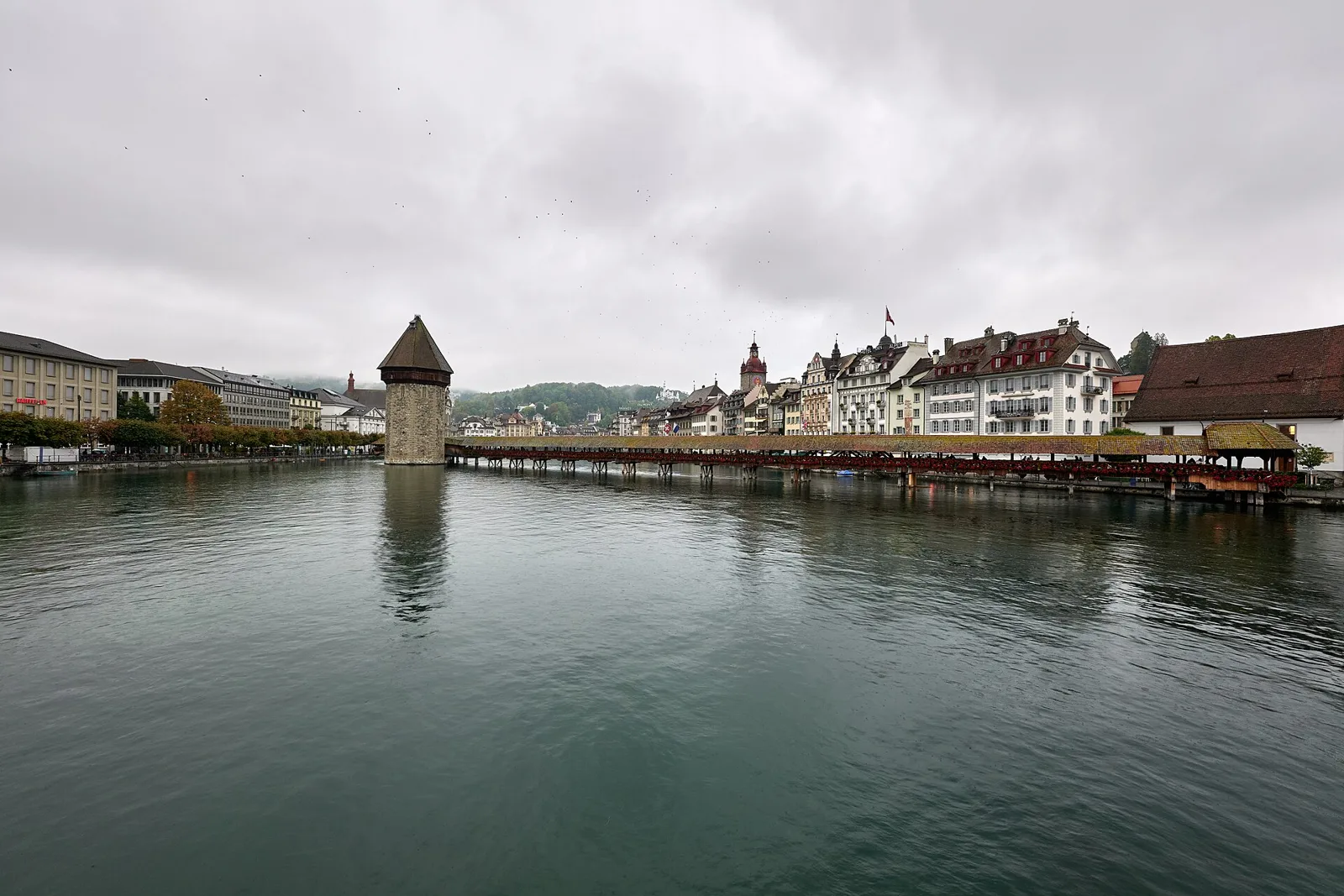
Lucerne is the Switzerland people picture before they arrive: a medieval old town wrapped around painted wooden bridges, a lake ringed by mountains, and two classic Alpine outings, Pilatus and Rigi, that start at the boat pier outside the station. The Kapellbrucke and Spreuerbrucke cross the Reuss between frescoed gables, and paddle steamers still run the lake fleet out to Alpnachstad, Vitznau and beyond.
The verdict in 30 seconds
Our pick: Lucerne (runner-up: Lucerne plus a Jungfrau village)
Pick Lucerne. It is the better town on most reports, a real city with a lake, museums and three mountains within the hour, while Interlaken is a transit strip whose value is everything around it; the only case for Interlaken is a Jungfrau-focused stay, ideally sleeping in the villages above it.
Go if
- Choosing one Swiss base between a lake city and the Bernese Oberland
- First-timers wanting the classic Swiss mix of town, lake and mountains
- Deciding whether Interlaken works as a base, a day trip or a skip
Skip if
- You have only two or three nights and one is already booked
- Your whole itinerary is the Jungfrau region; then Interlaken-side logic applies by default
The options
Lucerne Go
First-timers and mixed parties wanting the full Swiss card: a real city, a lake, museums, and Pilatus, Rigi and Titlis all inside an hour.
Good
- A real town, not a hub: old-town lanes, riverside dining and museums that rescue rainy days.
- The boat-and-mountain menu: Pilatus, Rigi and Titlis all reachable in an hour or so.
- Weather-proof: museum and old-town days bail out forecasts that would sink a summit ticket.
Watch out
- Mid-range hotel prices sit high and summer packs the centre with day-trippers.
- The adrenaline menu is thin; nothing here matches canyoning or tandem paragliding.
- For a Jungfrau-focused week it is the wrong end of the line.
Search hotels in Lucernepartner site
Interlaken It depends
Jungfrau-region itineraries: Grindelwald, Lauterbrunnen, Schilthorn, Jungfraujoch and the adventure-sports menu all branch from its two stations.
Good
- The gateway position: every Oberland line radiates from it, and one hotel can cover a whole week of mountain days.
- Adventure-sport capital: paragliding, canyoning and rafting launch from town.
- The guest card covers local transport, and hostel and budget stock runs deeper than Lucerne's.
Watch out
- The town itself is the region's least interesting stop: a transit strip reports describe as useful rather than charming.
- The marquee spend is a gamble: Jungfraujoch runs CHF 239 return and fails in cloud.
- Town-side extras price like the station they serve; reports flag queues and tourist menus.
Search hotels in Interlakenpartner site
Lucerne plus a Jungfrau village Go
Trips of five nights or more: city nights in Lucerne, then mountain nights in Wengen, Muerren or Grindelwald, linked by the panoramic train.
Good
- The veteran recipe in the reports: the better town plus the better base for the summits.
- The Luzern-Interlaken Express turns the transfer into a sightseeing leg of under two hours.
- Village nights buy the atmosphere Interlaken itself lacks, with the railways still at the door.
Watch out
- Two bookings and a hotel change mid-trip.
- More planning: village rooms and summit weather windows need coordinating.
- Costs both the city premium and the mountain premium.
Interlaken on a Lucerne day trip Skip
Almost nobody; it exists mostly as an itinerary idea that reports talk down.
Good
- Logistically simple: one direct panoramic train each way.
Watch out
- Nearly four hours of rail to reach the region's least interesting stop.
- The same ticket reaches Lauterbrunnen or Grindelwald, where the point actually is.
- A cloudy day spent 'seeing Interlaken' wastes a Lucerne day better spent on Pilatus or the lake.
| Criterion | Lucerne | Interlaken | Lucerne plus a Jungfrau village | Interlaken on a Lucerne day trip |
|---|---|---|---|---|
| What the place is | A real city that happens to sit on a lake | A transit hub with great views | The city plus a mountain village | The region's least interesting stop |
| The draw | Old town, lake boats, Pilatus, Rigi, Titlis | Jungfraujoch, Grindelwald, Lauterbrunnen, adventure sports | Both lists in sequence | A train ride |
| Rainy-day plan | Museums, covered boats, restaurants | Thin: the bill is the forecast | The city days absorb it | A wasted return fare |
| The marquee spend | Pilatus Golden Round Trip, about CHF 120 | Jungfraujoch return, CHF 201 to 239 | Both budgets combined | Four hours of rail for little payoff |
| Realistic stay | 2 to 4 nights | 3 to 7 nights for the Oberland | 5 or more nights total | None |
| Getting there | About an hour from Zurich airport | About two hours via Bern or the panoramic line | Under two hours between bases | 1h50 each way on the direct train |
What it costs
- Luzern-Interlaken Express, 2nd class one-way: CHF 34 (The direct panoramic link between the two bases in under two hours, running 365 days; seat reservation CHF 12 off-season and CHF 16 May to October). Official source, checked Oct 2026.
- Jungfraujoch return from Interlaken Ost: CHF 239.20 (CHF 239.20 in the May to October season and CHF 201.20 in winter, before any seat reservation; the Oberland's marquee spend). Official source, checked Oct 2026.
- Pilatus Golden Round Trip, 2nd class: CHF 119.80 (Lucerne's answer to Jungfraujoch: boat, cogwheel railway and cable car in one loop, running May to October; CHF 84 return on the railway alone). Official source, checked Oct 2026.
What travelers report
Based on 12 traveler reports (Feb 2025 to Aug 2026) and the official sources linked on this page. 0 were negative.
What people like
- Reports overwhelmingly call Lucerne the better town: a real old city with a lake, against a gateway that is useful rather than lovely.
- The Oberland's marquee day still draws the strongest verdicts: incredible for some reports, a calculated weather-and-price gamble for others.
- The recurring veteran play is the split: city nights in Lucerne, then mountain nights in Wengen, Muerren or Grindelwald.
- The Luzern-Interlaken Express earns praise as a ride worth taking for itself, panorama windows over pass and lakes.
What people complain about
- Interlaken the town is the weak link: reports call it a transit town and suggest sleeping in the villages instead.
- Summit weather can burn a CHF 200-plus ticket day in cloud; reports treat Jungfraujoch as the trip's gamble.
- Town-side extras feel overpriced: one report's Harder Kulm stop felt far too expensive and too busy to enjoy.
- Lucerne's peak season packs the old town with day-trippers and prices rooms to match.
How to do it right
- Pick Lucerne for a first trip, a short stay or a mixed party: city, lake and three mountains from one base.
- Pick Interlaken when the Oberland is the itinerary; Grindelwald, Lauterbrunnen, Schilthorn and Jungfraujoch all branch from it.
- Sleep up-valley rather than in Interlaken proper when atmosphere matters; Wengen, Muerren and Grindelwald are the forum favorites.
- Ride the Luzern-Interlaken Express between bases: a direct panoramic line under two hours, seat reservation advised in season.
- Check the summit forecast the night before a Jungfraujoch day; the ticket does not care about clouds.
- Do not day-trip to Interlaken from Lucerne just to see it; nearly four hours of rail reaches the region's least interesting stop.
The trap to avoid
Booking Interlaken for the name and sleeping in the transit strip, or day-tripping to it from Lucerne. Reports agree the town is the region's least interesting stop; the same ticket reaches Lauterbrunnen or Grindelwald, where the point actually is.
What to do instead
The answer
Pick Lucerne. The reports are nearly unanimous that it is the better town: a real city with an old town, a lake promenade and museums, against a gateway that is useful rather than lovely. Lucerne’s own mountain menu is strong: Pilatus, Rigi and Titlis all sit inside about an hour, and a Pilatus Golden Round Trip runs about CHF 120 against CHF 239 for Jungfraujoch. Rainy days have somewhere to go.
Interlaken’s case is real but narrower: it is the rail hinge of the Bernese Oberland, and when Grindelwald, Lauterbrunnen, Schilthorn and Jungfraujoch fill the itinerary, basing there is simply efficient. The reports that push back are consistent: the town is a transit strip, so sleep in Wengen, Muerren or Grindelwald for the village feel, and check the summit forecast before a CHF 239 day.
Doing both
The Luzern-Interlaken Express links the two in under two hours on a panoramic line that runs daily, so the classic answer is a split stay: a few nights of city, lake and low-altitude mountains in Lucerne, then a few nights up in the Jungfrau villages. What the reports warn against is the day-trip version: nearly four hours of rail to see Interlaken itself, when the same ticket reaches the valleys where the scenery actually is.
Book or check times
Luzern-Interlaken Express infoJungfraujoch prices and ticketsPilatus railway and cableway prices
We earn a commission if you book through our links. It never changes a verdict. How this works
Search hotels in Lucernepartner siteSearch hotels in Interlakenpartner site
Questions
Lucerne or Interlaken: which Swiss base?
Lucerne for most trips: it is the better town, a real city with a lake, museums and three mountains inside an hour. Pick Interlaken only when the Jungfrau region is the whole plan, and even then consider sleeping in the villages.
Is Interlaken worth staying in?
As a gateway, yes: everything in the Oberland connects through it. As a place to sleep, the reports are blunt: a transit strip, with Wengen, Muerren and Grindelwald suggested instead.
Can I do Lucerne and Interlaken in one trip?
Easily, and it is the veteran answer. The direct panoramic train links them in under two hours, so a split of city nights in Lucerne plus mountain nights in the Oberland covers both.
Which is cheaper, Lucerne or Interlaken?
Beds run cheaper in Interlaken and its hostel stock is deeper, but the Oberland's activity bill is steeper: Jungfraujoch alone runs CHF 239 return in season against CHF 120 for Lucerne's Pilatus loop.
How far is Lucerne from Interlaken?
Under two hours on the direct Luzern-Interlaken Express, a panoramic train that runs every day of the year; add a CHF 12 to 16 seat reservation in season.
Pack for it
Gear verdicts from our sister site, Real Buyer Experiences: