Graz / The verdict
Is Graz's old town and Hauptplatz worth it?
Graz's UNESCO-listed old town is the city's living room: Renaissance facades, Austria's best farmers market six days a week and a walkable core that reports call cheaper than Vienna or Salzburg.
By The Real Traveler Experiences team.
The Graz story
Graz is the Austrian city that gets on with being pretty without performing it: a UNESCO-listed Renaissance old town spread under the Schlossberg's clock tower, the blue bubble of a Kunsthaus floating beside the Mur, an artificial island in the river, Eggenberg's 24 staged Baroque state rooms, and a South Styrian wine road on the doorstep. It is Austria's second city at student pace, and the food is better than the fame.
The verdict in 30 seconds
Go
Graz's UNESCO-listed old town is the city's living room: Renaissance facades, Austria's best farmers market six days a week and a walkable core that reports call cheaper than Vienna or Salzburg.
Go if
- First-time visitors: nearly every report puts the old town at the center of a Graz day
- Slow travelers: the lanes, courtyards and cafes reward wandering without a checklist
- Market people: the Kaiser-Josef-Markt behind the opera runs Monday to Saturday mornings
- Advent trips: the Hauptplatz hosts the main Christkindlmarkt plus the Rathaus light projection
Skip if
- You need big-city nightlife or shopping scale: Graz's center is compact and quiet by evening
- You are only in town on a Sunday: the farmers market and most shops are shut
- You expect blockbuster monuments: the old town's appeal is the whole fabric, not one sight
What it costs
- Old town, Hauptplatz and markets: €0 (Free at all hours; the Kaiser-Josef-Markt runs Mon-Sat mornings). Official source, checked Oct 2026.
- Graz Card, 24 hours: €32 (48 h is 42, 72 h is 47; covers zone-101 transport incl. Schlossberg rides, Joanneum museums and a guided old-town tour; two children under 15 free per card). Official source, checked Oct 2026.
What travelers report
Based on 12 traveler reports (Jan 2025 to Sep 2026) and the official sources linked on this page. 0 were negative.
What people like
- Reports call the historic center beautiful and Graz a favorite Austrian city: Renaissance facades, courtyards and almost no tourist crush.
- Everything sits within walking distance and the city reads as cheaper than Vienna or Salzburg.
- The Kaiser-Josef-Markt six mornings a week keeps the old town a working neighborhood rather than a stage set.
- December transforms it: the Hauptplatz Christkindlmarkt plus an Advent calendar projected across the Rathaus.
What people complain about
- Sunday shuts it down: the market and most shops stay closed.
- The quiet cuts both ways: evenings are calm and the shopping scale is modest.
- It is a fabric, not a checklist: travelers expecting monumental set pieces can find it low-key.
- The market stalls must close by early afternoon, so lie-ins miss it.
How to do it right
- Start at the Hauptplatz and let the lanes lead: the tourist office hands out three self-guided walking routes through the core.
- Do the Kaiser-Josef-Markt on a weekday morning: it runs Monday to Saturday until about 13:00 behind the opera.
- Look up: the Luegghaus stucco facade hides faces in its garlands, and the Landhaus courtyard is the city's Renaissance showpiece.
- Ride the Altstadtbim: trams run free between the Hauptplatz, Jakominiplatz, Schlossbergplatz and the Kunsthaus stops inside the old town.
- Come back in Advent if you can: the Hauptplatz hosts the Christkindlmarkt and a huge Advent calendar projection on the Rathaus.
The trap to avoid
Treating the old town as a checklist stop. Its value is the fabric itself, so budget unplanned wandering time rather than a lap of the main square.
What to do instead
Why this verdict
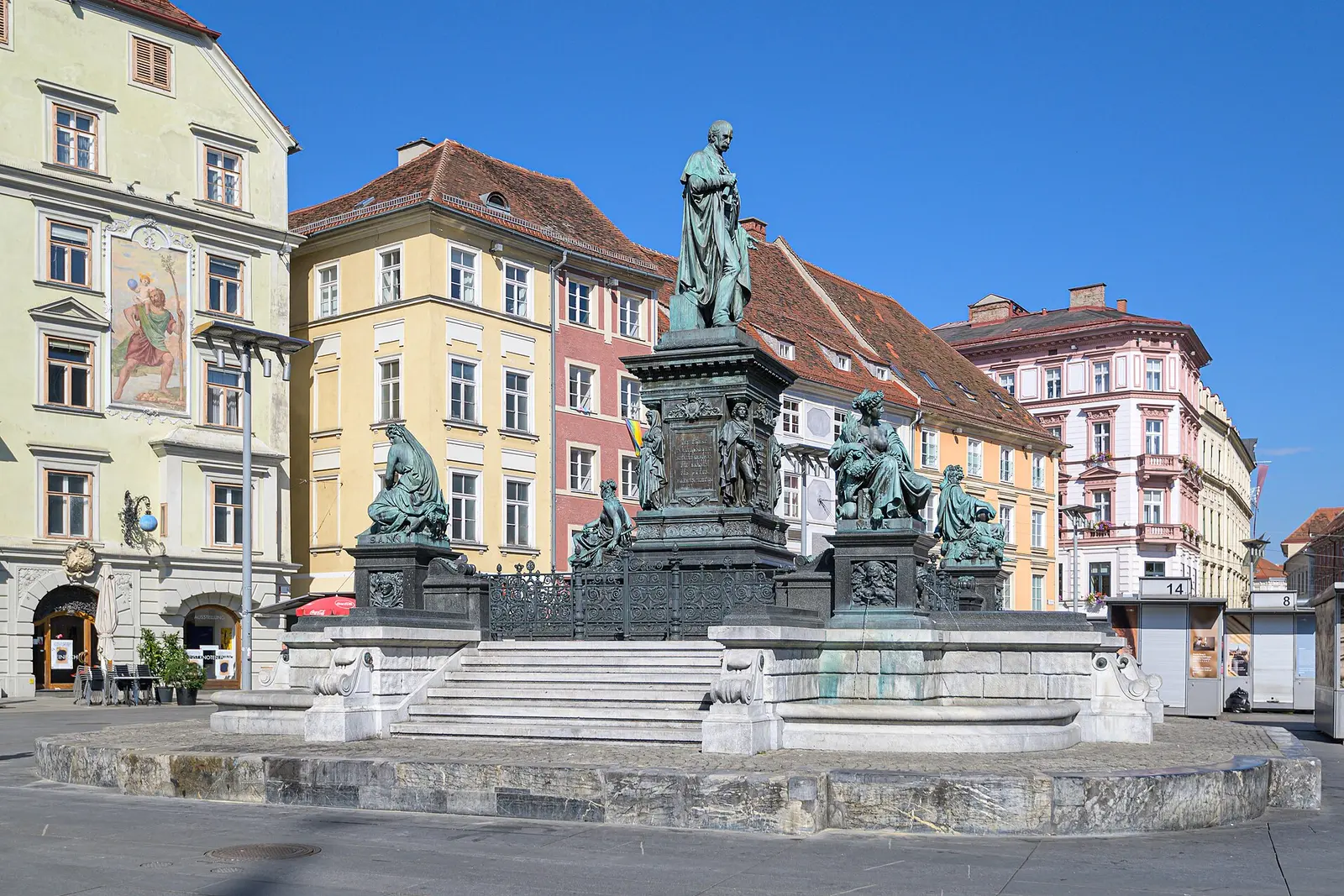
Graz’s old town earns its UNESCO listing in the way reports actually describe it: not as a monument to tick off, but as the city’s living room. Travelers keep circling back to the same picture: Renaissance facades, the fountain and the Rathaus on the Hauptplatz, arcaded courtyards like the Landhaus, and a center small enough to cross on foot in minutes. One account calls Graz his favorite Austrian city; another points out it is cheaper and calmer than Vienna or Salzburg.
The market is the proof the place still works for locals. The Kaiser-Josef-Markt behind the opera runs six mornings a week until early afternoon, and reports treat it as a sight in itself. Sundays and holidays shut it, which is the main caveat on timing.
The lanes reward the unplanned. The tourist office’s three self-guided walking routes take in Herrengasse, the Luegghaus stucco facade and the hidden courtyards; travelers who followed them report the old town holding up as the day’s anchor rather than a side stop. Free tram hops on the Altstadtbim link the Hauptplatz with Jakominiplatz, Schlossbergplatz and the Kunsthaus, so even a short stay covers the core without paying a fare. In Advent the Hauptplatz hosts the Christkindlmarkt under a giant calendar projected onto the Rathaus, and smaller markets scatter a short walk away.
Timing and tickets
Nothing to book: the whole core is free. Go on a weekday or Saturday morning to catch the market, and save the museums for their ticketed hours. A Graz Card adds a guided old-town walk plus transport if you are stringing sights together.
Book or check times
Hauptplatz and town hall, official guideKaiser-Josef-Markt, official guideLandhaus courtyard, official guideAltstadtbim: free old-town tramsGraz Card incl. free walking tour
Questions
Is Graz's old town free?
Yes: the squares, lanes and courtyards are free at all hours, and only the museums inside them charge.
What is the Hauptplatz?
Graz's main square: the Erzherzog-Johann fountain, the Rathaus and the tram hub, plus the Christkindlmarkt in Advent.
When does the farmers market run?
The Kaiser-Josef-Markt behind the opera opens Monday to Saturday mornings and closes at 13:00; Sundays and holidays stay shut.
How long does the old town take?
Reports cover the core on foot in two to three hours; the tourist office's three walking routes stretch it into a day.
Is Graz's old town really UNESCO listed?
Yes, since 1999, with Schloss Eggenberg added to the listing in 2010.
Pack for it
Gear verdicts from our sister site, Real Buyer Experiences: